


It Isn’t All About You (Or Me): The Power of Projection in Relationships
Understanding Privilege: Meaning, Types, and Impact on Daily Life
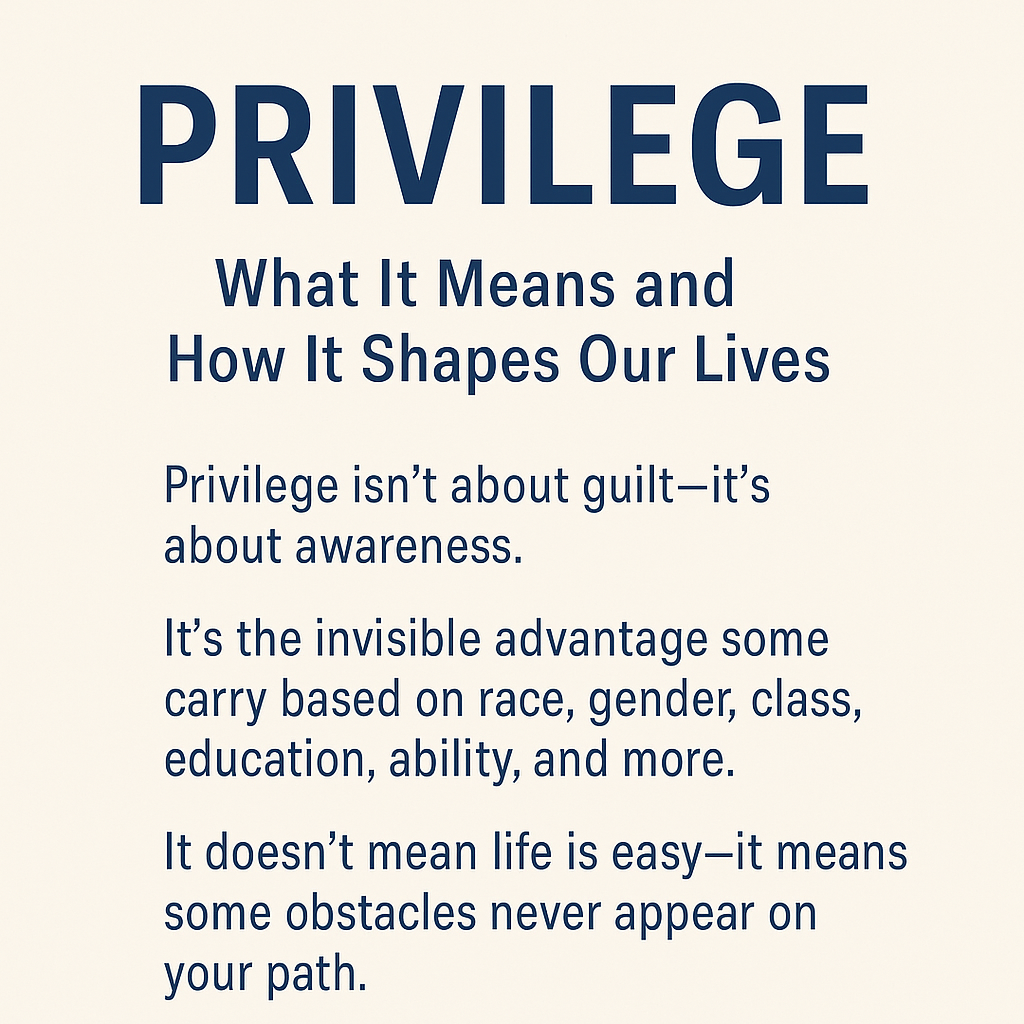
Privilege: Understanding What It Means and How It Shapes Our Lives We hear the word privilege often, sometimes with discomfort, sometimes with confusion, sometimes with resistance. But what does it really mean—and how does it quietly, yet powerfully, shape the way we move through life? Let’s start here: Privilege is not about guilt. It’s about awareness. What is Privilege? At its core, privilege is an unearned advantage. It’s the invisible backpack some of us carry—full of tools, access, and shortcuts we didn’t ask for but benefit from nonetheless. Privilege can show up in many forms: race, gender, socioeconomic status, education, physical ability, sexuality, language, mental health, age, and more. It’s not that having privilege makes life easy. It’s that certain obstacles others face may not even appear on our path. For example: A white person may not fear being racially profiled when shopping. A man may not experience being spoken over in meetings. A wealthy person may never have to choose between rent and groceries. A straight person doesn’t have to “come out” repeatedly or fear violence for who they love. A neurotypical individual may not have to justify their communication style or sensory needs. These are not criticisms—they are simply recognitions of reality. Different for Everyone Here’s the nuance: privilege is not a binary. It’s not about being privileged or not; it’s about the unique combination of experiences each of us holds. You may be privileged in one area and marginalised in another. A disabled white woman may benefit from racial privilege while facing challenges of accessibility and ableism. A working-class man may have gender privilege but struggle with classism and economic instability. Nothing sits in isolation—everything is connected. Our identities and experiences are multi-layered, and our privileges and disadvantages interact with each other constantly. Why It Matters When we’re unaware of our privilege, we can unintentionally invalidate others’ experiences. We might say, “If I can do it, anyone can,” without realising that the playing field is uneven from the start. Privilege can blind us to other people’s barriers—and worse, make us believe those barriers don’t exist. When we’re aware of our privilege, we gain the opportunity to act with empathy, allyship, and equity. We can become bridge-builders, not gatekeepers. We can use our influence to amplify voices that are often silenced or sidelined. How It Shapes Our Lives Privilege shapes everything: the jobs we get, the safety we feel, the expectations placed on us, and the ways we see ourselves and others. It can dictate the questions we never have to ask, and the fears we never have to feel. That’s why privilege is not something to deny—it’s something to acknowledge, explore, and use wisely. So What Can You Do? Reflect: Ask, Where might I have privilege? Where might I not? This is not about shame; it’s about truth. Listen deeply: Especially to those whose experiences differ from yours. Listening is a radical act. Challenge assumptions: Be curious about the systems you’re a part of. Ask, Who benefits? Who’s excluded? Use your voice: If you have access others don’t, speak up—but not over. Keep learning: Privilege is complex, and our understanding of it should evolve. Final Thoughts Wealth is more than money. Privilege is more than comfort. It is the often-invisible structure around us that either holds us up or holds us out. You are your own power base—but recognising your privilege helps you use that power consciously. If we all walked toward this awareness—rather than brushing it under the carpet—we could create a world that works for more people, not just the few. #ConsciousLeadership #SelfAwareness #SuccessSuite

GRIEF by Ruth Owen
I had a routine appointment at the hospital the other day.

The Origins of Butterfly Kisses: A Tale of Eternal Love
Once upon a time, in the dawn of the world, before words were born to express love, there existed a quiet, sacred gesture between mothers and daughters, butterfly kisses. Long before grand speeches or songs could capture the depth of emotion between them, the soft fluttering of eyelashes against a cheek became the language of love, trust, and an unbreakable bond that would transcend life itself. The legend of butterfly kisses begins with a divine gift, bestowed by nature itself. In an ancient meadow, far beyond the horizon, lived a mother and her daughter, bonded by a love so pure that the stars seemed to brighten when they were together. One summer evening, as the two sat under the canopy of a starlit sky, a gentle breeze stirred the flowers, and the first butterfly was born. The butterfly’s wings, delicate and fragile, danced in the air like a living dream, and as it landed softly on the daughter’s cheek, the mother noticed how her child giggled and glowed, the tickle of the wings filling her heart with joy. The mother, moved by this small but wondrous moment, leaned in close and fluttered her eyelashes against her daughter’s face, mimicking the butterfly’s tender touch. The daughter’s laughter rippled through the air, and in that fleeting instant, they shared something more than words, a feeling of infinite connection. The mother, with tears in her eyes, whispered, “This is how I will always touch you, even when you cannot see me. I will always be with you, my love.” From that moment, butterfly kisses became their promise—an expression of love that would bind them forever, beyond the limits of time. They discovered that unlike the fleeting touch of hands or the sound of voices that fade, butterfly kisses carried with them something eternal. Each gentle brush of eyelashes against the skin was like a whisper of the soul, a reminder that love is not bound by physical distance, by age, or even by death. Over the centuries, mothers passed this tender gesture to their daughters. It became a ritual of love, often shared in the quiet moments before bedtime or at times of deep need, when the world felt too heavy, and the heart longed for the reassurance of love. Butterfly kisses became more than just a simple touch—they became a symbol of connection, a silent vow that no matter what life brought, no matter where time carried them, they would always have each other. In life, butterfly kisses are shared in moments of joy and sorrow. A mother, cradling her newborn for the first time, gives the gift of butterfly kisses to her daughter, as if passing down the light of the stars themselves. In moments of celebration, it is the flutter of love that binds them together. And in times of pain or loss, when words cannot ease the ache, it is the softest of kisses that reminds them: Love never dies. And even when a mother’s time in this world has passed, the memory of butterfly kisses lives on. For each daughter carries with her the touch of her mother’s love, stored within her very being. In moments of stillness, when she closes her eyes, she can feel the gentle flutter on her cheek, as if the very wings of her mother’s soul are brushing against her, whispering that she is never truly alone. As generations pass, the love between mothers and daughters deepens through this sacred tradition. Butterfly kisses connect them to the lineage of women who came before and to the future daughters who will carry the legacy forward. It is a love that is born with the first flutter of life and continues long after the last breath has been taken. It is a reminder that the bond between mother and daughter is as eternal as the stars themselves. Butterfly kisses are, in their essence, the promise that love is immortal. They are the bridge between this world and the next, the way that mothers and daughters can continue to speak in the language of the heart, even when time separates them. For though hands may fade and voices grow distant, love remains. Love flutters softly, like the wings of a butterfly, gently brushing against the soul, reminding us that we are forever held, forever cherished. And so, in every corner of the world, whether whispered across oceans or shared in the quiet of a home, butterfly kisses continue to flutter from one generation to the next—a gesture of infinite love, a reminder that no matter where life or death takes us, the bond between mother and daughter is unbreakable, eternal, and ever-present. For love, like butterfly kisses, transcends all.

Understanding Abuse: Breaking the Cycle Without Blame
What is Abuse? Abuse is a powerful word and is not something anybody will want to be called or accused of, and sadly, many are an abuser and do abuse without the knowledge they are, believe it when they are told, or change when someone informs them and provides the opportunity.